Friday, May 13, 2011

Brewing Up Variety At Ithaca

These days, a craft brewer can’t rely on one or two good beers and expect beer aficionados to stick with them. Craft beer drinkers demand variety. Give them an eclectic selection of quality beers and they’ll pay you back with loyalty.

That’s a lesson Ithaca Beer Co. out of New York knows well. This small regional brewery – distribution only reaches as far as New York, New Jersey, Pennsylvania, and a few surrounding states – is all over the map in terms of the styles they offer. Even better, they make a darn good beer. That’s probably why you’re seeing Ithaca beers appear in more and more good liquor stores in New Jersey.

Among their five year-round beers are CascaZilla, a big, hoppy red ale that clocks in at 7% ABV. It’s got a reddish hue and a full, malty body, but the star of the show are the Cascade hops. Most reds are pretty mild and, frankly, forgettable. Not CascaZilla.

But if it’s hops you like – hops are the part of beer that gives it its bitterness, as well as aromas that can smell of pine, citrus, and more – Ithaca’s Flower Power IPA is where you want to go. This beer has a huge, citrus-filled, floral aroma that is surprisingly pungent (in a good way) for the price. The beer is bitter but highly drinkable even at 7.5% ABV. It’s a year-round beer but is released in limited quantities, so if you see it scoop it up. It's one of the best IPAs brewed on the East Coast.

Ithaca’s best-known beer is by far their Apricot Wheat. It’s available all year long and is their best seller. This isn’t a beer for someone who doesn’t like sweet beverages. The apricot is not subtle. It’s right up front and in your face, making this a fruity brew perfect for a hot day. Try one of these while sitting poolside.
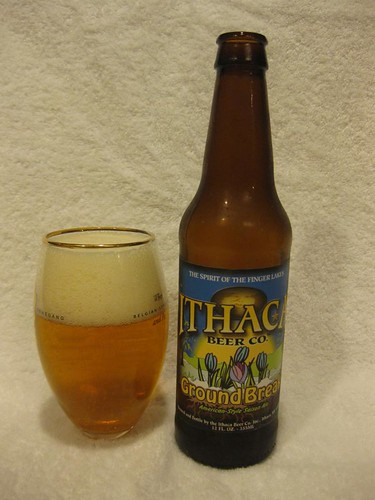
Like all good craft breweries, Ithaca also does an array of seasonal beers, including a smoked porter and Belgian amber ale in the winter. Right now, you should be able to find the last six-packs of Ground Break, an American style saison that should go down wonderfully on a pleasant spring day. Saisons are light-bodied Belgian beers known for their subtle fruity character and zesty, refreshing taste. Well worth tracking this one down, because they stop releasing it in April. Starting in May, Ithaca will be putting out Partly Sunny, a wheat ale brewed with coriander, lemon zest and spices. That’s good summer drinking right there.

Like so many of the great craft beers now appearing in better liquor stores, Ithaca is a regional beer. You can find their beers in New York, Ohio, Pennsylvania, Vermont, New Hampshire, Maine, Massachusetts, Rhode Island, New Jersey, and Connecticut. You can locate distributors here.

Monday, May 9, 2011

The Wonderful World of Hops

If you enjoy beer, you know the word “hops.” And as you’ll discover a little further down in this column, right now your better liquor stores are offering a rare chance to get a tasty education in hops.

Along with water, malted barley, and yeast, hops are one of the four primary ingredients in beer. They are a vine-like plant closely related to the hemp plant. Hops, however, have no properties that will induce “altered states.” They’re in beer solely for taste.

Hops provide bitterness to counteract the heavy sweetness of the malted barley used to make beer. Without them, beer would be a sickly sweet and syrupy. They also have some preservative properties. The best known story showcasing this is the origin of the popular India Pale Ale, or IPA, style of beer. As the story goes, this beer was developed with a more robust dose of hops in order to ensure the beer kept during the long voyage to India. (There is some dispute among beer historians about this tale.)

Not all hops are created alike. Some impart a mild bitterness. Others such as those used in big American IPAs give citrus aromas or pine-like scents. Others are “grassy.” Brewers routinely blend hops to get the desired effect, so in any given beer you may be tasting a blend of two, three, four or more different hop strains.

Want to taste the difference? Right now, Samuel Adams is offering a limited edition 12-pack that serves as a hops lesson in a box. Their Latitude 48 IPA Deconstructed pack takes their Latitude 48 IPA, which is made with a blend of five hops that grow along the 48th latitude line, and breaks it down into a series of single-hop versions of the same beer. In each 12-pack you get two bottles of the IPA, then two bottles each of versions that use the same water, yeast and malted barley, but just one of the five hops used in the beer – Hallertau Mittelfrueh (a German hop), the famous English hop East Kent Goldings, and three great American hops grown in Washington state, Ahtanum, Simcoe, and Zeus. That means you get six different IPAs in the box, five of the six showcasing the unique taste of an individual hop.

The idea isn’t entirely new. For example, Mikkeller, a Danish brewer, has a single-hop line, but it’s far out of the price range of the average beer lover.

So for about $14 you can get a great education in hops, all while enjoying some Samuel Adams. Better grab it fast, though. This is a limited release and isn’t likely to last.

Oh yeah, and maybe in a future post I’ll discuss why “triple-hopped” is meaningless bullshit.

Friday, May 6, 2011

Chasing down the elusive KBS (Kentucky Breakfast Stout)

Note: I brought this post over from my main blog.

Founder's Kentucky Breakfast Stout, aka KBS, is an amazing, hard to find beer because the once-a-year brew sells out so fast, but it's well worth the trouble of tracking it down. Here's why.


There is a reason why Ratebeer rates it a world class beer and ranks it as one of the top 10 beers in the world based on thousands of reviews. It's quite simply one of the most complex, rich, and flavorful beers you'll ever have. Folks who have only experienced the usual Bud-Miller-Coors style beers are probably unaware that beer can be like this.

I was lucky to even get it. I had been bugging the guys at my local liquor store two months ahead of time. "Do you think you'll be able to get the KBS? Please set a few bottles aside for me!" Turns out my entire state only got 120 cases. Otherwise good liquor stores were #25 or #30 on their distributor's list to get a case ... and those distributors had maybe four cases to dish out. Yikes.

But my shop did get it, and they set aside two bottles for me. (Few shops sold this in the four-packs it comes in. Instead, most imposed one- or two-bottle limits on customers.) I'm glad they did. This stuff was a treat.

This is an imperial stout brewed with huge amounts of coffee and chocolate, both of which are very much a part of this heady, chewy brew's taste and aroma. It's rich and dark and very full-bodied. Founders sends the taste into the stratosphere, though, when they cave age it for a year inside oak bourbon barrels. The result is a beer loaded with flavors that all compete for center stage without crowding one another out.

KBS has a strong, up-front bourbon taste with hints of vanilla in the aroma. Give it a whiff and you'd almost think you're smelling a dense liquor. It's a beer through and through, though. After the initial burst of bourbon at the start of your sip, coffee and chocolate rise up in the middle, with hints of vanilla working to counter the mocha taste. The balance is perfect. As you finish your sip you're left with a lingering, oaky bourbon finish.

All in all, it wasn't just a beer, it was an experience. If by some amazing chance you see some, grab it. Otherwise, be ready to act fast when next year's batch is released. It's already in barrels.

Wednesday, May 4, 2011

A (delicious) trip through beer history

Beer tastings can be fun. Instead of just getting together with some friends to have a few drinks -- hopefully good drinks -- you're all trying new beers, discussing what you're tasting, offering your impressions, and generally having a nice shared experience. It's not a snobby, aren't-we-refined thing, it's just a good time.

Plus, beer!

A few weeks ago, I hosted a beer tasting with a fun theme. Over the course of eight beers (in smaller, sample-sized portions, natch, not eight full beers) we took a trip through beer history. Along the way we experienced a wide array of styles and beer experiences. Here are the brews we tasted, in order.

9,000 BC

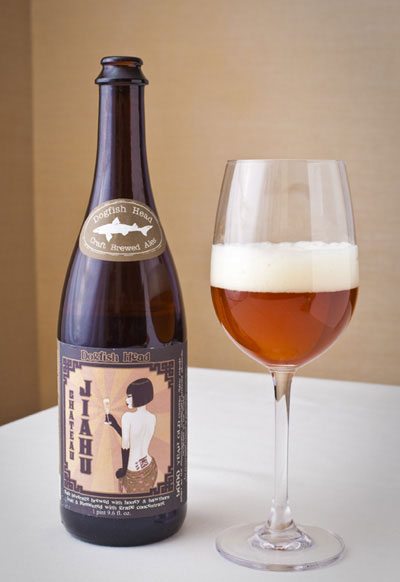
We started 9,000 years in the past in ancient China with a beer based on the ingredients of the oldest known alcoholic beverage, Dogfish Head's Chateau Jiahu. Going by chemical analysis of ancient pottery, "Dogfish brewers use brown rice syrup, Orange Blossom honey, Muscat grape, barley malt, and hawthorn berry.The wort is fermented for about a month with Sake yeast until the beer is ready for packaging." This beer has strong floral qualities, smelling like a champagne but tasting closer to a lightly malted beverage. Interesting modern twist on what this beverage may have tasted like.


--------------------

740 BC

We then jumped ahead a few thousand years to the time of King Midas in what is now known as Turkey, where we indulged in Dogfish Head's Midas Touch. This beer is also brewed with accurate ingredients as per chemical analysis of an archeological dig site. According to Dogfish, this tastes "somewhere between wine & mead; this smooth, sweet, yet dry ale will please the Chardonnay of beer drinker alike." My friends and I likened it to a crisp, somewhat sweet white wine with the feel of a champagne. Definitely an interesting beer that is best served with a meal.

--------------------


The Dark Ages

From there we leapt into the medieval era. Before brewers discovered the hop plant was great for beer -- beer is the result of sugars fermenting, so in order to be something other than sickly sweet it needs additional ingredients to add bitterness -- they used a mixture of herbs and spices for bittering called "gruit." It was used for at minimum hundreds of years, possibly thousands, and was a mainstay in medieval beers. When hops came along, hopped beers and gruit beers were at war with one another. Took about 150 years for hops to take over, and pretty much every single beer ever since then has been made with hops. Enter Steenbrugge Dubbel Bruin. This beer is a Belgian dubbel made with gruit brewed in a traditional medieval style. The beer had many of the characteristics of a Belgian dark beer -- malty, with hints of caramel, figs, and plums -- but the bitterness had a dank, Earthy quality to it. It wasn't my favorite beer of the day, but it was interesting to try it.

--------------------

900 AD

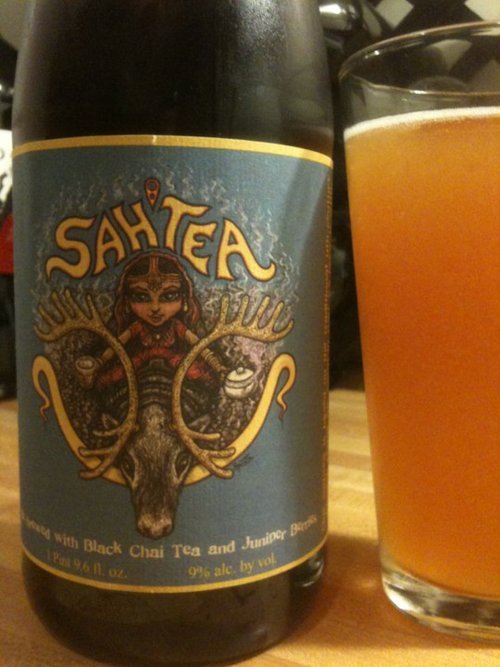
We then moved to 9th Century Finland for traditional Finnish Sahti with a slightly modern twist. Dogfish Head's Sah'Tea is brewed with juniper berries, along with a tea-like concoction made black tea, cardamom, cinnamon, ginger, cloves, and black pepper. Oh yeah, and it also happens to be heated using white hot rocks dropped directly into the beer. Check the link above and watch the accompanying videos for the interesting story behind this brew. How well did this one go over? Like a champ. It was already one of my favorites. When I mentioned I planned to buy a case of it this year, several of the folks on hand wanted to split it with me. Needless to say, it went over well.

--------------------

1595

Our next stop was Belgium circa the 1500s for a Trappist beer that has been brewed continuously for centuries. I've already blogged extensively about the great beers from the Rochefort brewery, so I won't repeat myself here. Instead I'll just say that this essential stop on our journey through the history of beer was as delicious as the first time I had it.


--------------------


1776
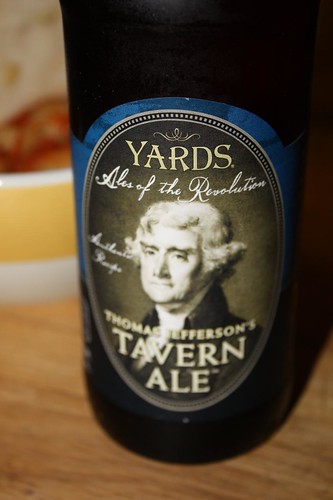
For our final beers, we hopped across the pond to pay a visit to the Founding Fathers with some beers brewed from their original homebrew recipes -- including ingredients grown on Jefferson's estate. All three were from Yards' Ales of the Revolution series, which includes George Washington's Tavern Porter, Poor Richard's Tavern Spruce Ale, and Thomas Jefferson's Tavern Ale. The porter was hearty and rich, with touches of molasses and a hint of chocolate flavor. Very delicious. The tavern ale was a potent (8% ABV) golden ale with a full body. Tasty stuff. And the spruce ale tasted like a Christmas tree. I'll not be drinking that one again.


And that was our little jaunt through beer history. It was a fun day of seeing just how varied beer can be. Later this summer, we'll be tackling an array of Belgian beers, focused on Belgian whites and golden ales. Should be fun!

Friday, April 29, 2011

Ready for some beer?

Ahhh, beer. Is there nothing it can't do?

Folks who know me know I'm a beer enthusiast. Not a beer snob, but certainly a beer geek. I love to get geeky talking about beer styles and ingredients and how unusual beers are brewed and beer history and on and on and on. People around me probably get sick of hearing about it!

I've discussed beer once or twice on my main blog, but decided beer talk would be better off done in its own little domain.

So that's what I plan to do here. To talk beer. To review great beers and talk about my homebrewing experiences and discuss beer history and great breweries. To just plain geek out over beer.

Hopefully, someone out there is willing to listen!

If you like beer, pull up a chair, pour yourself a pint, and enjoy.